

Asian Petrochemical Market Scan
Weekly Analysis of the Global Petrochemical Products Market; Aromatics Rise Against MEG and Acetic Acid Decline
A Review of Petrochemical Product Price Changes in Asian Markets from October 2 to 9, 2026
The global petrochemical products market witnessed a mixed trend between October 2 and 9, 2026, as a group of products—particularly styrene, toluene, and methanol—experienced price increases, while ethylene, monoethylene glycol (MEG), and acetic acid faced price declines or stability in some markets. This divergence in performance indicates that the Asian petrochemical market during this period was driven less by a broad upward or downward trend and more by product-specific supply and demand conditions.
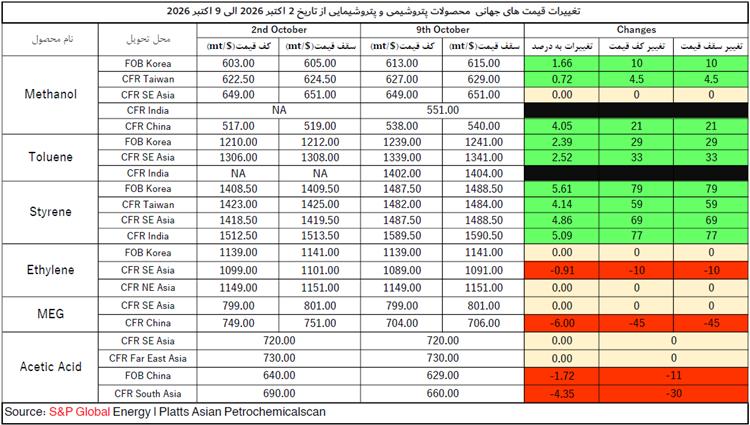
A review of data published with reference to S&P Global Energy and Platts shows that for a precise analysis of these changes, one must consider not only the percentage price fluctuation but also the dollar amount of change, the geographic market position, and the trading status of each product.
1. Market Overview; Winners and Losers of the Week
The most significant changes recorded in the table are:
| Product and Market | Oct 2 Price | Oct 9 Price | Price Change | Percentage Change |
|---|---|---|---|---|
| Styrene, FOB Korea | 1,409.50 | 1,488.50 | +$79 | +5.61% |
| Styrene, CFR Taiwan | 1,425.00 | 1,484.00 | +$59 | +4.14% |
| Styrene, CFR Southeast Asia | 1,419.50 | 1,488.50 | +$69 | +4.86% |
| Methanol, CFR China | 519.00 | 540.00 | +$21 | +4.05% |
| Toluene, CFR Southeast Asia | 1,308.00 | 1,341.00 | +$33 | +2.52% |
| Ethylene, CFR Southeast Asia | 1,101.00 | 1,091.00 | -$10 | -0.91% |
| MEG, CFR China | 751.00 | 706.00 | -$45 | -6.00% |
| Acetic Acid, FOB China | 640.00 | 629.00 | -$11 | -1.72% |
| Acetic Acid, CFR South Asia | 690.00 | 660.00 | -$30 | -4.35% |
All prices are in dollars per metric ton. In rows with ceiling and floor prices, the figures from the main table have been used as the basis.
Among the markets reviewed, South Korean styrene recorded the largest percentage increase, rising $79 per ton, a gain of 5.61%. On the other side, Chinese MEG recorded the largest percentage decline among comparable rows, falling $45 per ton, a drop of 6%.
This divergence highlights the importance of examining aromatic and ethylene derivative chains separately.
2. Styrene; Leading the Price Increases
Styrene experienced price increases in all four reported markets. The product's price in the FOB Korea market rose from $1,409.50 to $1,488.50 per ton. Additionally, the CFR India price increased by $77 to reach $1,590 per ton.
The breadth of price increases across different markets indicates that styrene's rise was not limited to a single trading destination. Rising raw material costs—particularly benzene—regional supply conditions, and inventory levels are among the important factors that can influence this product's price.
However, a styrene price increase does not necessarily mean improved profitability for its producers, because if benzene and other production input costs rise faster than styrene's selling price, producer margins may be squeezed.
Commercial implication: Styrene consumers in the polystyrene and related resin industries should examine not only the daily price but also raw material cost trends and supplier inventories. Staged purchasing can reduce the risk of entering at an unfavorable price point in volatile markets.
3. Toluene; Continued Upward Trend in Asian Markets
Toluene prices rose in two markets with comparable data. In the FOB Korea market, the price rose from $1,212 to $1,241, an increase of $29. In the CFR Southeast Asia market, the price rose from $1,308 to $1,341 per ton.
The simultaneous rise of both indicators can be a sign of strengthening toluene prices in the region. However, price differences between markets, freight costs, delivery terms, and supply constraints remain important in commercial decision-making.
Toluene is used in solvents, paints and coatings, and the production chain of certain chemicals. Therefore, its price increase can raise raw material procurement costs for part of the downstream industries.
4. Methanol; Significant Growth, but Not Uniform Across All Markets
Methanol prices rose in the FOB Korea, CFR Taiwan, and CFR China markets, while the CFR Southeast Asia market remained unchanged.
In the CFR China market, the price rose from $519 to $540 per ton—a $21 increase equivalent to 4.05%. In the FOB Korea market, the price rose from $605 to $615.
In contrast, the CFR Southeast Asia price remained stable at $649–651. This difference shows that the methanol market situation cannot be assessed by a single regional indicator alone.
China's Golden Week holiday in early October had limited trading activity, and a clearer assessment of demand depended on market participants returning after the holiday. An S&P Global Energy report had previously indicated expectations of lower-volume trading and the impact of regional supply constraints on the market for certain chemicals.
Source: S&P Global Energy – Asian Petrochemical Market Review, Week of October 5–9
Commercial implication: Rising methanol prices in China can increase feedstock costs for some chemical production units. However, for buy or sell decisions, market inventories, regional prices, and freight costs should also be examined.
5. Ethylene; Limited Decline in the Southeast Asian Market
Ethylene prices in the CFR Southeast Asia market fell from $1,101 to $1,091 per ton—a decline of $10, or 0.91%.
In the FOB Korea and CFR Northeast Asia markets, prices remained nearly unchanged. Therefore, the observed decline is specific to one market and cannot be generalized to all ethylene markets.
Weak downstream demand, available supply levels, and operating conditions of production units are factors influencing ethylene prices. Asian market reports in early October also pointed to weak spot demand and pressure on the olefins market.
For polyethylene and other ethylene derivative producers, lower feedstock prices can help improve margins if finished product prices remain stable. However, the final outcome depends on downstream product selling prices and other production costs.
6. MEG; Largest Percentage Decline in the Table
Monoethylene glycol (MEG) in the CFR China market experienced a significant decline. The product's price fell from the $749–751 ceiling and floor range to $704–706. As a result, the price change was negative $45 at both levels, registering a 6% decline.
In contrast, MEG prices in the CFR Southeast Asia market remained unchanged at $799–801.
This regional difference is highly significant: the Chinese price decline does not necessarily mean an identical price drop across all of Asia. Domestic supply conditions, import volumes, inventories, and consuming industry demand can cause price trends to diverge.
MEG is primarily consumed in the polyester and PET production chain. Its price decline can reduce feedstock costs for downstream producers; however, if finished product prices also fall simultaneously, producer profitability will not necessarily increase.
Important note for buyers: The 6% decline in Chinese MEG is a significant signal for reviewing sellers' offered prices; however, for Iranian importers, freight costs, payment terms, exchange rates, and delivery times must also be factored into calculations.
7. Acetic Acid; Downward Pressure in China and South Asia
Acetic acid prices declined in the FOB China and CFR South Asia markets. In the Chinese market, the price fell from $640 to $629, a decrease of $11. In the South Asian market, the price fell from $690 to $660, equivalent to a $30 or 4.35% decline.
In contrast, CFR Southeast Asia and CFR Far East Asia prices remained unchanged.
This pattern shows that the acetic acid price decline is also regional in nature. Differences in supply conditions, warehouse inventories, consuming industry demand, and freight costs can maintain price gaps between markets.
For industries consuming acetic acid and its derivatives, this price decline can be an opportunity to renegotiate with suppliers. Of course, before deciding on bulk purchases, the sustainability of the downward trend and actual supply conditions must be examined.
8. Market Analysis for Iranian Importers and Downstream Industries
For chemical raw material market participants in Iran, Asian price changes gain more commercial value when analyzed alongside import costs and domestic market conditions.
Four points are particularly important in this regard:
Separation of regional markets: FOB Korea, CFR China, and CFR Southeast Asia prices are not identical indicators. Each has different delivery terms and cost structures and should not be directly compared without necessary adjustments.
Examination of total import cost: The global price is only one component of the purchase price. Freight, insurance, port fees, payment terms, exchange rates, and other import costs can change the final price.
Avoiding generalization of one trend to all products: Rising styrene and toluene prices do not mean all petrochemical materials are rising simultaneously. The decline in MEG and acetic acid and the limited ethylene drop are examples of divergent market behavior.
Use of staged purchasing and daily monitoring: In volatile markets, purchase decisions should be based on current inventory, consumption levels, replenishment timing, and product price trends—not merely on a one-week increase or decrease.
To forecast raw material prices in Iran, global price trends must be combined with exchange rates, domestic supply conditions, producer announced prices, and logistics costs. One-week changes alone are not sufficient for definitive domestic price forecasting.
9. Summary and Short-Term Outlook
The October 2–9, 2026 data carry three main messages for the Asian petrochemical market:
Upward trend: Styrene, toluene, and methanol rose in several regional markets; South Korean styrene led with a 5.61% gain.
Downward trend: Chinese MEG with a 6% decline and South Asian acetic acid with a 4.35% decrease experienced the greatest downward pressure among comparable rows.
Stable or mixed trend: Ethylene and certain indicators for methanol, MEG, and acetic acid remained unchanged in specific markets.
Overall, this period can be described as a week of divergent performance across petrochemical chains, with aromatic product gains juxtaposed against weakness in some ethylene derivatives. The market's next direction will depend on supply stability, Chinese demand recovery after the holidays, feedstock prices, and downstream industry operating conditions.
For Iranian buyers and sellers, the main message is that price analysis must be product-specific and market-specific. Simultaneous monitoring of global prices, regional market differences, and total import costs provides a more accurate basis for commercial decision-making.
Price data source: Table provided with reference to S&P Global Energy / Platts Asian Petrochemicalscan. The prices in this report pertain to the October 2–9, 2026 period and should not be considered real-time market prices.

Comments (0)
Post a comment