

Asian Petrochemical Market Scan
Analysis of Global Petrochemical Product Price Changes: Noticeable Decline in Methanol, MEG, and Acetic Acid Versus Growth in Ethylene and Toluene
Review of Global Petrochemical Market Trends from October 9 to 23, 2026
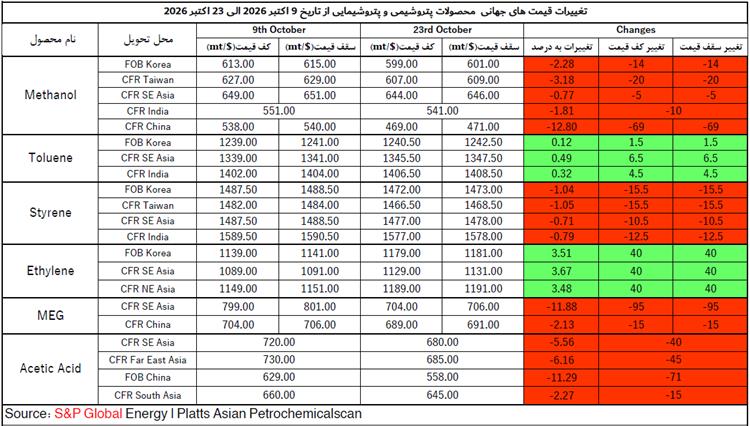
The global petrochemical products market witnessed significant changes in base and intermediate product prices in the second half of October 2026. A review of data published by S&P Global Energy | Platts shows that between October 9 and 23, most of the products examined experienced price declines; however, some products, including ethylene and toluene, experienced an upward trend contrary to the general market direction.
A review of 21 price rows relating to six main products—including methanol, toluene, styrene, ethylene, monoethylene glycol (MEG), and acetic acid—shows that 15 rows recorded price decreases and 6 rows recorded price increases. This situation indicates the dominance of downward pressures on a significant portion of the Asian petrochemical market during this period.
1. Methanol: The Strongest Downward Pressure in the Chinese Market
Methanol is one of the products that experienced a significant price decline during the period under review. This decline was recorded in all regional markets, but the severity of the price drop in the Chinese market was far greater than in other regions.
The most important methanol price changes are as follows:
• FOB Korea: a decrease of USD 14 per ton, equivalent to 2.28%.
• CFR Taiwan: a decrease of USD 20 per ton, equivalent to 3.18%.
• CFR Southeast Asia: a decrease of USD 5 per ton, equivalent to 0.77%.
• CFR India: a decrease of USD 10 per ton, equivalent to 1.81%.
• CFR China: a decrease of USD 69 per ton, equivalent to 12.80%.
The methanol price in the CFR China market fell from a range of USD 538–540 to USD 469–471 per ton.
The 12.8% decline in methanol prices in China is the most important change recorded among the products in this report. The noticeable difference between the performance of the Chinese market and other regional markets may indicate weak domestic demand, increased supply pressure, or a change in competitive conditions in this market.
Since China is one of the most important consumers and importers of methanol in the world, the continuation of this trend could also affect regional prices and the purchasing decisions of industrial consumers in other Asian markets.
2. Toluene: Moving Against the Market's Downward Trend
In contrast to the price declines of many petrochemical products, toluene recorded price increases in all three markets examined.
Toluene price changes are as follows:
• FOB Korea: an increase of USD 1.5 per ton, equivalent to 0.12%.
• CFR Southeast Asia: an increase of USD 6.5 per ton, equivalent to 0.49%.
• CFR India: an increase of USD 4.5 per ton, equivalent to 0.32%.
The highest toluene price growth was recorded in the Southeast Asian market, where its price rose from a range of USD 1,339–1,341 to USD 1,345.5–1,347.5 per ton.
Although the magnitude of toluene's price growth was limited, the simultaneous price increase in all three regional markets is important. This trend could stem from differences in supply and demand conditions, the state of the aromatics market, and demand from downstream industries.
Overall, toluene was one of the few products with positive performance in the Asian petrochemical market during this period.
3. Styrene: Price Declines in All Regional Markets
Styrene experienced price declines in all markets examined between October 9 and 23.
The recorded changes are:
• FOB Korea: a decrease of USD 15.5 per ton, equivalent to 1.04%.
• CFR Taiwan: a decrease of USD 15.5 per ton, equivalent to 1.05%.
• CFR Southeast Asia: a decrease of USD 10.5 per ton, equivalent to 0.71%.
• CFR India: a decrease of USD 12.5 per ton, equivalent to 0.79%.
The largest percentage decline was recorded in the Taiwan market, and the largest absolute price declines were recorded in the Korean and Taiwan markets.
Styrene, as one of the important raw materials in the production of polystyrene, ABS, and certain industrial resins, is directly linked to the condition of downstream industries.
The simultaneous decline in styrene prices across various Asian markets may indicate a weakening trading environment for this product. In analyzing its future trend, examining benzene and ethylene prices, feedstock costs, and demand conditions in polymer-producing industries is particularly important.
4. Ethylene: The Largest Price Increase Among the Products Examined
Ethylene is one of the most important products in this report, and contrary to the prevailing downward trend in the market, it experienced a significant price increase.
In all three markets examined, ethylene prices increased by exactly USD 40 per ton:
• FOB Korea: an increase from USD 1,140 to USD 1,180 per ton, equivalent to 3.51%.
• CFR Southeast Asia: an increase from USD 1,090 to USD 1,130 per ton, equivalent to 3.67%.
• CFR Northeast Asia: an increase from USD 1,150 to USD 1,190 per ton, equivalent to 3.48%.
During this period, the Southeast Asian market recorded the highest relative increase, with growth of 3.67%.
The simultaneous increase in ethylene prices across various regional markets may indicate strengthened supply and demand conditions or higher production and procurement costs.
Since ethylene is the main raw material for polyethylene production and one of the key feedstocks in the chemical products production chain, its price increase can affect the cost of producing downstream products, particularly polyethylene and ethylene derivatives.
These changes are of particular importance to producers and buyers of polymer raw materials.
5. Monoethylene Glycol (MEG): Sharp Price Decline in the Southeast Asian Market
Monoethylene glycol (MEG) experienced one of the largest price declines during this period.
MEG price changes in the markets examined:
• CFR Southeast Asia: a decrease of USD 95 per ton, equivalent to 11.88%.
• CFR China: a decrease of USD 15 per ton, equivalent to 2.13%.
The MEG price in the Southeast Asian market fell from a range of USD 799–801 to USD 704–706 per ton.
A notable point in this section is the very large difference in the magnitude of the price decline between the Southeast Asian and Chinese markets. While MEG prices in Southeast Asia fell by nearly 12%, the decline in the Chinese market was only 2.13%.
This difference could stem from differences in supply conditions, regional demand, inventory levels, and the structure of transactions in these two markets.
MEG is one of the key raw materials in the production of polyester fibers, unsaturated polyester resins, and PET. Therefore, a decline in its price, if passed through the supply chain, can affect the raw material costs of the textile industry, synthetic fibers, PET bottle production, and polyester resins.
For MEG market participants, simultaneously monitoring paraxylene prices, purified terephthalic acid (PTA), operating rates of production units, and inventory levels in Chinese warehouses is of great importance.
6. Acetic Acid: Price Declines in All Markets Examined
Acetic acid also followed a downward trend during the period under review, with all four regional markets recording price declines.
Price changes are as follows:
• CFR Southeast Asia: a decrease of USD 40 per ton, equivalent to 5.56%.
• CFR Far East Asia: a decrease of USD 45 per ton, equivalent to 6.16%.
• FOB China: a decrease of USD 71 per ton, equivalent to 11.29%.
• CFR South Asia: a decrease of USD 15 per ton, equivalent to 2.27%.
The largest price decline was recorded in the FOB China market, where the acetic acid price fell from USD 629 to USD 558 per ton.
The significant price decline in the Chinese market may indicate increased supply pressure or reduced purchasing power among domestic consumers. On the other hand, price declines in other regional markets also show that the downward trend in acetic acid was not limited to one specific market.
Acetic acid is used in the production of vinyl acetate monomer (VAM), acetates, industrial solvents, and certain intermediate chemicals. Therefore, a decline in its price can affect the production costs of dependent downstream industries.
7. Comparison of Product Performance: Which Products Had the Largest Price Changes?
To better understand the market situation, comparing the largest price increases and decreases among the products during the period under review is of great importance.
Largest Price Decreases:
| Product and Market | Price Change | Percentage Change |
|---|---|---|
| Methanol CFR China | -USD 69 | -12.80% |
| MEG CFR Southeast Asia | -USD 95 | -11.88% |
| Acetic Acid FOB China | -USD 71 | -11.29% |
Largest Price Increases:
| Product and Market | Price Change | Percentage Change |
|---|---|---|
| Ethylene CFR Southeast Asia | +USD 40 | +3.67% |
| Ethylene FOB Korea | +USD 40 | +3.51% |
| Ethylene CFR Northeast Asia | +USD 40 | +3.48% |
This comparison shows that the greatest downward pressure was concentrated in the methanol, MEG, and acetic acid product groups, while ethylene had the most prominent upward performance among the products examined.
8. Outlook for the Global Petrochemical Market and Factors Affecting Future Price Trends
A review of price changes in the second half of October 2026 shows that the Asian petrochemical market is not in a uniform condition in terms of price direction. In fact, the simultaneous decline in prices of some base products and the increase in ethylene and toluene prices indicate differences in supply and demand conditions across different petrochemical chains.
For a more precise analysis of price trends in the coming weeks, attention to the following factors is essential:
Crude oil and naphtha prices: Changes in crude oil and naphtha prices affect the feedstock costs of many petrochemical units and can influence the direction of base product prices.
Supply and demand conditions in China: China, as one of the largest consumption and production hubs for petrochemical products, plays a determining role in shaping Asian prices. Inventory levels, import volumes, and the activity status of the country's downstream industries are important market indicators.
Production capacity and unit operating rates: Major maintenance, production shutdowns, startup of new units, and changes in the operating rates of petrochemical complexes can alter the supply-demand balance.
Downstream industry conditions: Demand from polymer, textile, packaging, resin, paint, and industrial solvent industries is one of the main factors determining consumption trends for base petrochemical products.
Transportation costs and international trade conditions: Maritime shipping costs, trade restrictions, exchange rates, and logistics conditions can affect the final prices of imported products in various markets.
Final Summary
Global petrochemical product price data from October 9 to 23, 2026, indicate the dominance of a downward trend across a significant portion of the Asian market. Methanol, MEG, and acetic acid experienced the largest price declines, and styrene also recorded price drops in all markets examined.
In contrast, ethylene grew by about 3.5% across various markets, and toluene recorded limited price increases, performing differently from the general market direction.
From the perspective of traders, producers, and suppliers of petrochemical raw materials, these changes are highly important for purchase planning, inventory management, and determining appropriate transaction timing. However, decisions about buying or selling should not be made solely based on two-week price changes; it is necessary to simultaneously examine feedstock trends, consumer demand, market inventories, and regional conditions.
Source: S&P Global Energy | Platts – Asian Petrochemicalscan
Analysis period: October 9–23, 2026
Price unit: US dollars per ton (USD/MT)
Comments (0)
Post a comment